Fadiouth · Senegal · 28 October 2026
Fadiouth, Senegal: An Island Built on Seashells
Linked to the Senegalese mainland by a wooden footbridge, Fadiouth is a small island whose paths crunch with generations of discarded seashells. Come for its unusual landscape, then slow down for tidal views, neighborhood life, and a cemetery shared by Christian and Muslim communities.
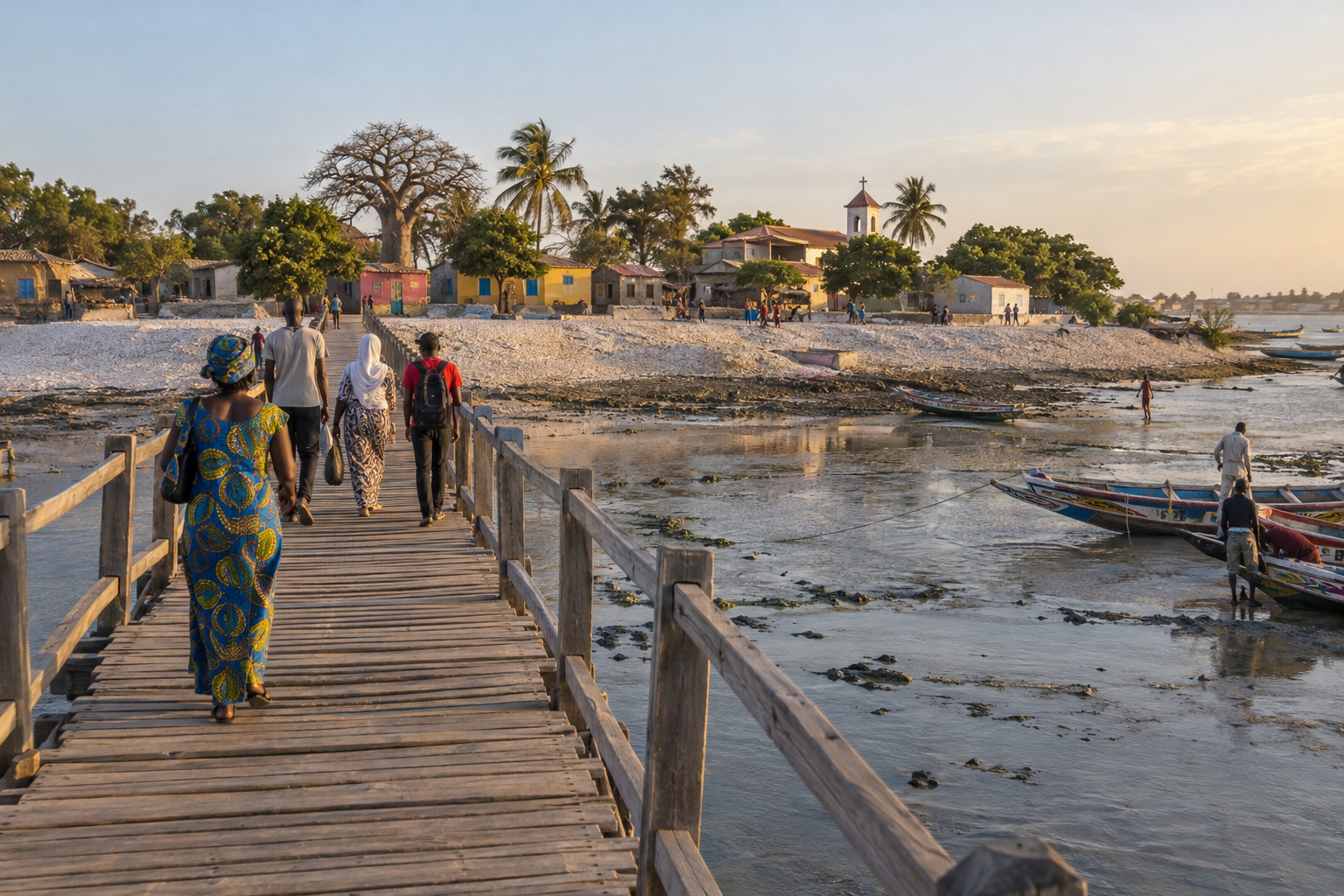
On Senegal’s Petite Côte, south of the busier beach resorts, a wooden bridge leads from Joal to somewhere that feels distinctly different. Fadiouth sits in a shallow tidal landscape, its pale lanes and island foundations formed from accumulated seashells. Underfoot, the ground crunches; beyond the houses, the water retreats to reveal broad mudflats.
This is not an undiscovered place—Senegalese visitors and organized excursions have long found their way here—but it rewards more time than a quick photo stop. Stay nearby, walk without rushing, and let the island’s everyday rhythms become the point of the visit.
Why it's special
Fadiouth’s defining material is also its most ordinary: shells. Generations of shellfish gathering helped create the island’s distinctive surface, and shells remain visible along paths and around buildings. In bright sunlight, the ground takes on a chalky glow against painted walls, shade trees, and the changing colors of the tidal shallows.
The island is closely associated with Serer culture, and its religious landscape is particularly striking. Unlike Senegal as a whole, where Islam is the majority religion, Fadiouth has a predominantly Christian population. Christian and Muslim residents share the island, and a second footbridge leads to a shell-covered cemetery with burial areas for both communities.
The cemetery is a place of remembrance, not simply a scenic attraction. Its crosses, graves, and baobab trees make a powerful impression, but the more meaningful story is the coexistence they represent. A thoughtful local guide can explain that history without reducing it to a neat slogan.
The surrounding water matters just as much. Depending on the tide, you may see boats afloat beside the island or resting near exposed flats. Even a short visit changes character as the water moves.
How to get there
Fadiouth is reached through Joal, the mainland town with which it forms the municipality of Joal-Fadiouth. Joal lies roughly 115 kilometers south of central Dakar by road. Allow around three hours from Dakar, sometimes longer: traffic leaving the capital and stops along the way can stretch the journey.
A prearranged car and driver is the simplest option, particularly if you want to combine the visit with an overnight stay. From Saly or Mbour, Joal is a more manageable excursion, although journey times still depend on your exact starting point.
For a lower-cost journey, use shared public transport toward Mbour and onward to Joal. Vehicles, departure points, and waiting times vary, so ask your accommodation for current instructions rather than relying on a rigid online timetable.
From the visitor area in Joal, continue on foot across the wooden bridge. Fadiouth’s lanes are explored walking, not by driving. Confirm any visitor charges and guiding arrangements at the entrance before setting off.
Best time to visit
November through April generally brings drier weather and more comfortable conditions for walking. December to February is especially appealing if you prefer less intense heat, although midday sun can still be strong.
The rainy season, broadly June through October, brings humidity and occasional heavy downpours. Visiting remains possible, but travel plans benefit from flexibility.
Aim for morning or late afternoon for softer light and cooler temperatures. Check the tide as well as the forecast: higher water emphasizes the island setting, while low tide reveals the working tidal landscape. Neither is inherently better; they simply tell different stories.
Rough costs
Senegal uses the West African CFA franc, abbreviated XOF. The following are planning estimates rather than fixed local tariffs:
- Simple meal: Allow approximately 2,000–5,000 XOF at a modest local restaurant; tourist-oriented places may charge more.
- Basic accommodation: Budget roughly 20,000–40,000 XOF per room for a simple guesthouse in the wider Joal area, depending on facilities and season.
- Shared transport: Set aside several thousand CFA francs per person for connections from Dakar, with extra for local transfers and luggage charges.
- Private excursion: A car and driver from Dakar can cost many tens of thousands of CFA francs. Request a full quote covering fuel, waiting time, and the return trip.
Keep a separate allowance for visitor fees, a local guide, and any boat outing. Agree prices and inclusions in advance, and carry small-denomination cash.
Tips
Wear comfortable shoes with reasonably sturdy soles: loose shells can be awkward under thin sandals. Bring drinking water, sunscreen, and a hat, as exposed stretches offer little shade.
Dress respectfully, especially around religious buildings and the cemetery. Ask before photographing people, and follow local guidance about photographing graves or ceremonies.
Choose a local guide who is happy to discuss everyday life as well as landmarks. Ask questions, but remember that residential lanes are people’s home territory.
Finally, leave shells where they are. Fadiouth’s appeal is not a souvenir to pocket, but a living place to encounter with care.
This article and its photo were created with AI. Prices, transport and opening times change — check the latest info and official travel advice before you go.